
Zara Lang · 13 October 2026
Regional Data Center Relocations and Shifts in Localized Search Visibility Patterns
Regional data center relocations occur when organizations move server infrastructure from one geographic area to another to address latency concerns, regulatory requirements, or operational costs, and these moves produce measurable effects on how search engines rank content in localized results over extended periods. Search engines rely on distributed crawler networks and data center proximity to determine relevance signals for users in specific regions, so changes in physical server locations can alter crawl frequency, index freshness, and visibility rankings in ways that persist beyond initial transition phases.
Core Mechanisms Behind Visibility Changes
Data centers house the physical infrastructure that supports website hosting and content delivery, while search engine crawlers operate from multiple global points of presence to scan and evaluate pages. When a site relocates its primary hosting to a new region, the distance between the content origin and regional crawler nodes shifts, which influences how quickly updates propagate through indexing systems. Studies from research institutions such as those affiliated with the University of Toronto have documented cases where sites experienced altered crawl rates following moves across continental boundaries, with some observing sustained differences in how local search results reflected the new server geography months after the transition.
Timing and Propagation Effects in October 2026
By October 2026, several large-scale infrastructure projects had completed regional shifts, including migrations from older facilities in North America to newer installations in Southeast Asia and Eastern Europe, driven by energy efficiency targets and data sovereignty rules. These changes coincided with updates to crawler scheduling algorithms at major engines, creating combined effects on localized visibility that extended well beyond the typical propagation window of days or weeks. Observers tracking performance metrics noted that sites undergoing such relocations often displayed revised ranking distributions in city-specific or country-specific queries, particularly when the new data center location aligned more closely with high-density user populations in those areas.
Long-Term Pattern Observations
Long-term visibility patterns emerge when initial ranking fluctuations stabilize into new baselines rather than reverting to pre-relocation states. Evidence from industry reports indicates that sites maintaining consistent content quality through the move tend to retain or improve local result placements when the target region offers lower latency to dominant user bases, whereas mismatches in time zones or regulatory environments can produce persistent suppression in certain localized queries. One documented instance involved a European retail platform that transferred operations to a Canadian facility, after which its visibility in North American regional searches increased gradually over six months while showing corresponding declines in some original European markets.
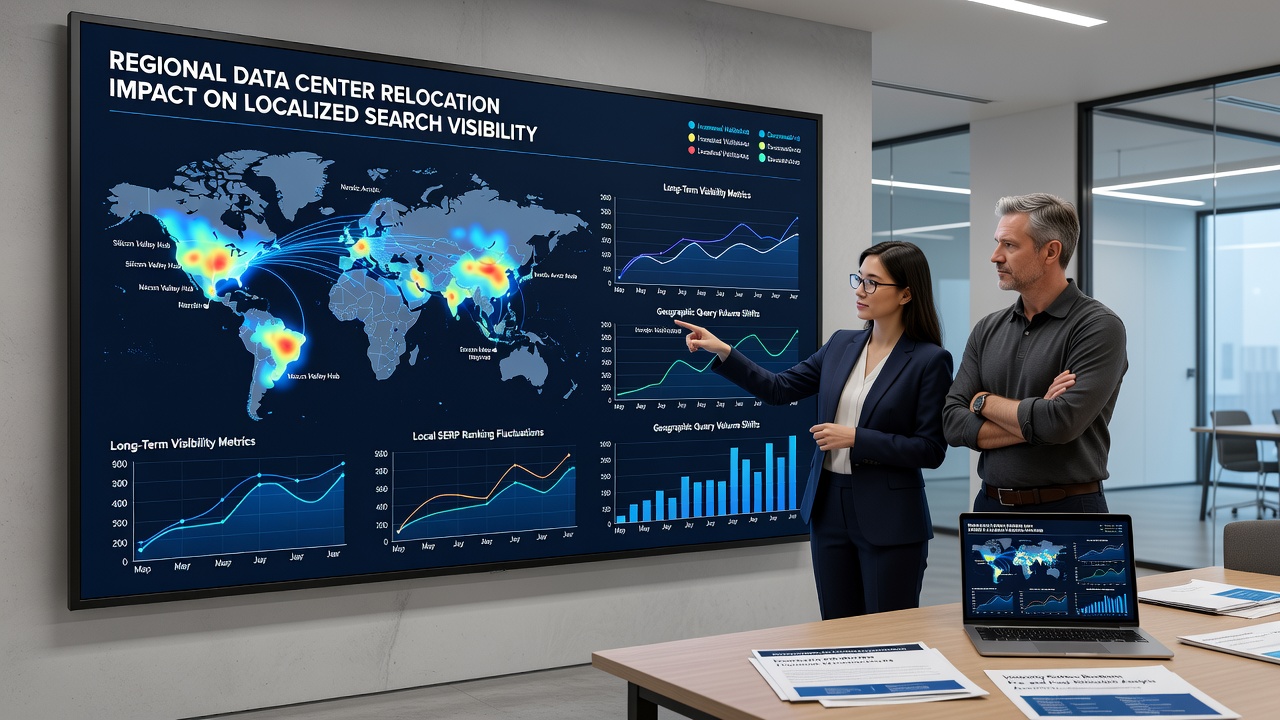
Additional factors include variations in how different engines prioritize proximity versus other signals such as backlink authority and content freshness. Researchers examining datasets from multiple relocation events found that engines with denser regional infrastructure adapted faster to the new hosting locations, resulting in quicker stabilization of localized rankings compared to engines with more centralized operations.
Influencing Variables and Geographic Considerations
Regulatory frameworks across regions shape these outcomes because data protection laws in the European Union and Australia impose specific requirements on where personal data can be stored and processed, often necessitating relocations that then intersect with search visibility dynamics. A report issued by the Australian Competition and Consumer Commission highlighted infrastructure adjustments made by several domestic platforms in response to cross-border data rules, noting subsequent shifts in how their content appeared in localized search interfaces. Similarly, analyses from Canadian academic sources have tracked how moves within North America produced subtler but still detectable changes in city-level result sets over multi-quarter periods.
Measurement Approaches and Data Sources
Professionals monitoring these patterns rely on tools that track crawl logs, index status changes, and position histories segmented by geographic parameters. Data from such monitoring shows that visibility stabilization typically occurs between three and nine months post-relocation, though outliers exist when content updates or algorithm adjustments intervene. Those studying the phenomenon emphasize the value of comparing pre-move and post-move performance across multiple engines rather than relying on single-source metrics, because engine-specific crawler distributions create divergent responses to the same infrastructure shift.
Conclusion
Regional data center relocations continue to influence long-term visibility patterns in localized search results through changes in crawler proximity, index propagation speed, and alignment with user geography. Organizations planning such moves benefit from examining historical cases from varied regulatory environments, including those documented in North American, European, and Asia-Pacific contexts, to anticipate how their content may perform in target markets after the transition completes. Ongoing observation of these dynamics remains essential as infrastructure landscapes evolve and search engines refine their methods for incorporating location-based signals into ranking decisions.